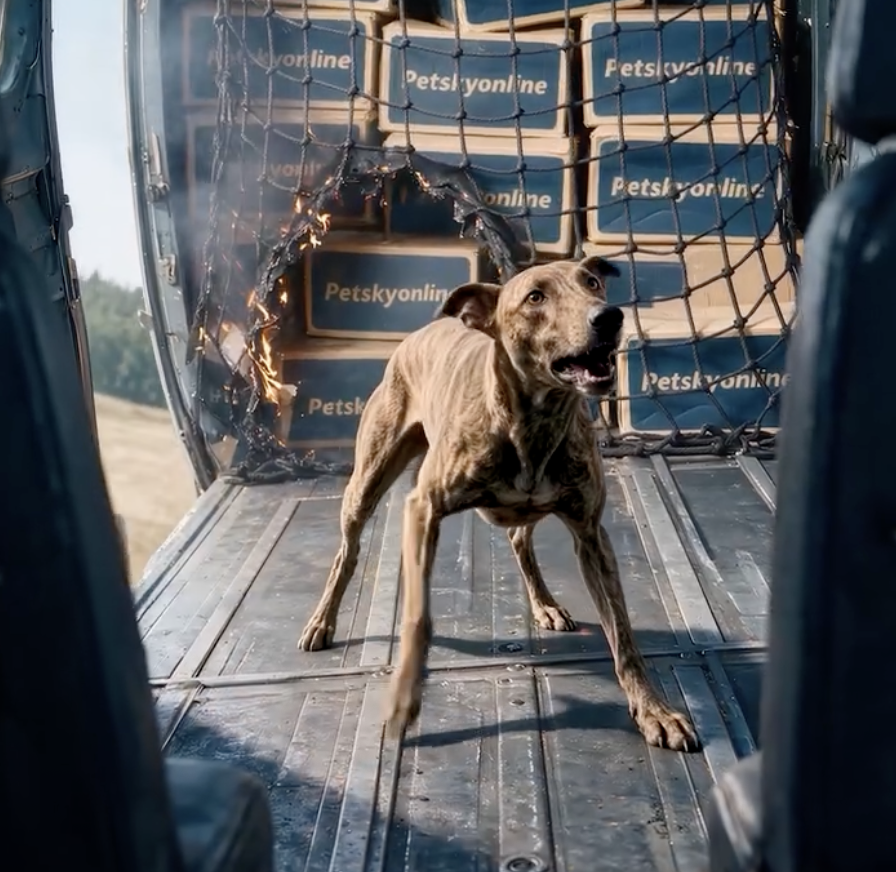
Arya Sedighi, the founder of Dubai-based Pet Sky Online, recently created an entertaining brand film that puts the products the company delivers into an original cinematic adventure. The four-and-a-half-minute Into the Wild video is presented in the vertical format, making it well suited for viewers on Instagram and TikTok.
The video takes on an action/adventure theme, with a Pet Sky plane going down in a remote jungle, scattering its clients’ food brands across the area and its range of wildlife. While the plane’s pilots don’t survive the crash, a lone dog is found and cared for by an indigenous tribesman, who protects it from a giant spider, aggressive wolf, hungry bear, pterodactyl and giant gorilla.
Sedighi operated alone to create the video, handling the concept, story and screenplay, as well as character & creature design, environments, editing, music and sound.
“The challenge was to do something genuinely different in the pet industry,” he explains. “Could a pet-shop advertisement become a film people would choose to watch for entertainment? Instead of familiar product-led pet advertising, I built an original cinematic adventure in which Pet Sky’s delivery service and the brands we offer become natural parts of the story. We believe this is the first time a pet shop has been promoted through an AI-generated film of this kind and scale.”
To date, the short has been viewed more than 3.3 million times on TikTok and more than 800,000 times on Instagram. It’s also been entered into the Los Angeles AI Motion Pictures Awards and the Astana AI Film Festival 2026.
“Almost all of the film was made through Higgsfield,” Sedighi explains. “I started with Seedance 2.0, which was the strongest option for my needs at the time. Even so, getting the output to match what I imagined required considerable experimentation. Moving to Seedance 2.5 made the process much smoother. I used ElevenLabs for the music.”
During the production process, Sedighi developed his own Seedance 2.5 prompting skills – a reusable set of specialized instructions that he could give to ChatGPT, alongside his scene ideas.
“It translated my descriptions into more precise, structured prompts, helping the output come closer to what I envisioned,” he shares. “This was not a new AI model I had trained, but a repeatable way of communicating my creative intentions to the tools.”
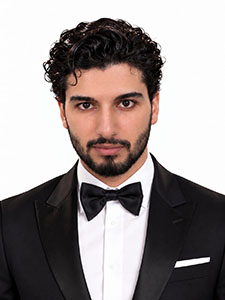
He also used acting and image-creation skills that Higgsfield had shared in connection with one of its short-film projects.
“Much of my own workflow came from trial and error, especially when existing tutorials did not address the specific problems I was encountering.”
Sedighi stresses the importance of high-quality reference images, which helped him more so than a text-based prompt. For example, for the island’s native warrior, the most effective reference came from a detailed close-up of the face against a plain, matte-grey background. A separate, front-facing full-body reference was also included, minus the head, as well as a rear view of the character.
“Excluding the head from the front body reference was particularly important,” he notes. “When I supplied a conventional full-body image, the small, less detailed face in it seemed to compete with the dedicated facial close-up, especially in wider shots. Separating them gave each reference a clear job: one for facial identity, another for the body and costume. That is an observation from my own results, rather than a claim about the model’s internal workings.”
In the Seedance 2.5 workflow, he could supply up to 50 references, allowing him to keep the images separate.
“In my earlier Seedance 2.0 workflow, I had combined the character views into a single reference sheet. For the dog and other four-legged creatures, I also found a full-body side view essential for communicating their proportions.”
Another time-saving technique that he developed involved a combination of carefully-prepared references and reusable, specialized instructions.
“The effect on production speed was substantial,” he notes. “The first 30 percent of the film took me roughly 20 days. Once I had refined the skills and reference images, I completed the remaining 70 percent in about 15 days.”