The Real Steel production presentation at SIGGRAPH 2012 illustrated
the benefits of including the VFX units from the very beginning of
production. A panel of industry veterans including Eric Nash and Ron
Ames and moderated by Mike Fink told the story of how Real Steel came
together as a production and what went into making it such a smooth
journey.
From the beginning the decision was made to include the VFX
representatives as collaborators in the film making process. The
close integration of CG robots with their practical counterparts as
well as the elaborate choreography of the CG fight scenes within
contained practical locations, required technical considerations to be
a central to production.
Rapid prototyping techniques were used to design and construct the
practical robot puppet components which provided 3D assets to Digital
Domain. This meant that DD had early visual targets to hit as well as
exact digital representations of the practical models. These early and
ongoing exchanges provided very clear visual criteria to drive
approvals in the look development process. By coupling these two often
disparate aspects of the visual development approvals process they
avoided many costly last minute technical changes.
The elaborate fight choreography meant that motion capture techniques
would have to be integrated to drive key narrative elements in the
film. Using the advanced virtual camera technology Simulcam,
pioneered at DD, to attain the necessary level of CGI/live action
cinematography meant that another aspect of the VFX crew was brought
in early on. The obvious benefits of having instant feedback of CG
element placement within the camera operator’s and director’s monitor
feeds, not only sped production along at the shoot, but also cut down
on extraneous takes usually made as “insurance” during post
production. It also seemed to play an important social role in
reinforcing the presence of the VFX crew as an integral component of
the daily shooting process.
A story from the shoot that illustrates this synergy was how VFX
stepped in to help iron out a major production wrinkle during the
Detroit location shooting of the fight sequences. Production was
unable to secure the two fight venues needed to shoot in on the time
frame in the schedule. The only location that was available was in
very bad physical shape.Since a majority of the location would have
been covered by CG crowds and set extensions anyway, DD suggested
creating entirely digital arenas, providing that production could
design the two environments within the constraint of keeping the arena
floors to a matching footprint. This saved the production time and
money and opened greater possibilities for the design of the fight
venues.
The panel’s overwhelming opinion was that the inclusion VFX at the
very earliest stages of pre-production on FX heavy shows, not only
smooths out technical hurdles but actually allows for greater creative
opportunity while keeping costs down. There is a definite feeling in
the VFX community that it is the redheaded stepchild of production
that is often called onto the job after everyone else is done, and
after their knowledge and unique expertise can help make the
production process much smoother. Once again we have evidence that a
well conceived plan carried out by a collaborative and inclusive team
of dedicated professionals can result in a project which can be
successfully completed with the minimal amount of difficulty. And just
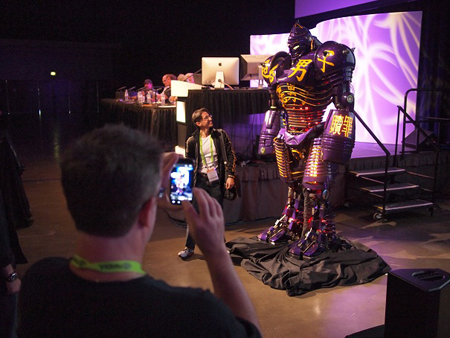
for fun, they also brought a full size version of the robot Noisy Boy,
with them which was a huge hit as a photo-op with the audience.