
The final battle sequence in The Avengers presented significant
technical and artistic challenges to Industrial Light and Magic. Jeff
White, Visual Effects Supervisor at ILM, gave a detailed analysis of
the techniques employed to create a digital environment for New York
City. Hundreds of HDRI (High Dynamic Range Imagery) panoramic
photographs were shot on location. These images coupled with detailed
building scans allowed ILM to fly the camera around NY. This approach
was necessary both for creature freedom in composing the shots as well
as to get around FAA regulations on flying helicopters between
buildings.
Pause a frame on the blu-ray edition and you may notice that the
office interiors of the buildings are offices from ILM.
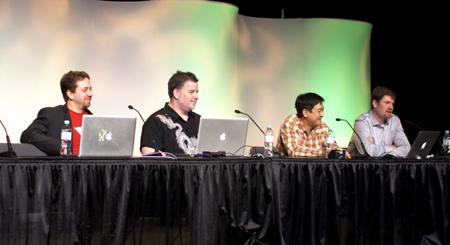
Marc Chu, Animation Supervisor at ILM, explored the great lengths they
went to in bringing The Hulk to the screen. Exhaustive scans, close up
photography, as well as a dental cast were used to more closely match
The Hulk to actor Mark Ruffalo. A body builder, dubbed “Green Steve”
was shot on set for performance and muscle reference. Cloth simulation
tests were shown that depicted areas where the shirt and pants would
tear to help sell the transition from human to Hulk. Additional break
downs detailing teeth sub-surface scatter tests and elaborate muscle
and skin simulation passes were shown.
Guy Williams, Visual Effects Supervisor at Weta Digital discussed the
numerous challenges in the mountain top and helicarrier engine
destruction sequences. Multiple fluid simulation elements were used to
convincingly depict smoke being ingested into the helicarrier’s
engines. Guy commented that their use of fluid simulation for smoke
effects elements has increased significantly over the last few years.
A new electrical spark tool was also developed for this project.
Aaron Gilman, Animation Supervisor at Weta Digital presented their
work on the Thor and Iron Man mountain top battle sequence. He
discussed the animation advantages when a shot moves from being a live
action plate with set extensions to a full 3D shot. They’re able have
complete control of camera and character choreography as well as
potential flexibility with shot duration. Aaron made frequent trips to
their motion capture suite to ensure physical accuracy for the digital
stunt work required. In the sequence, Iron Man briefly has the upper
hand and drags Thor along a cliff face at speed. Aaron showed several
takes of this shot including reference of him and another animator
working through the actions. This process allowed the audience to
explore with him the decisions that were made to ensure that the
character choreography served the story.