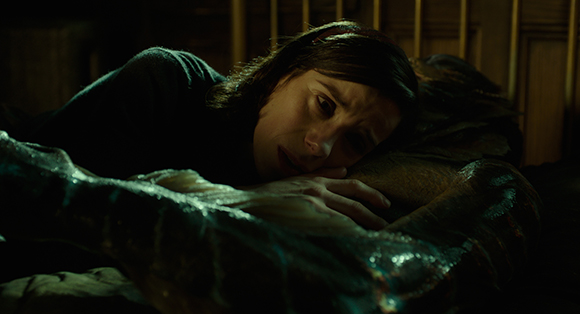
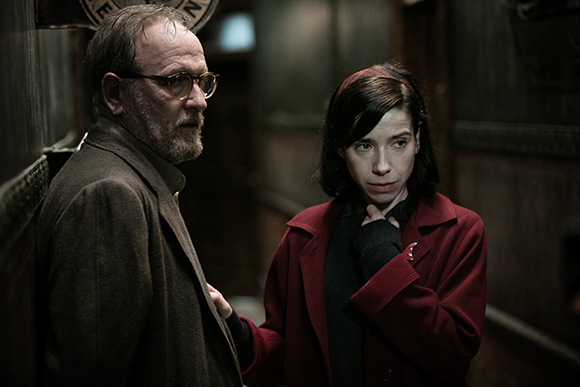
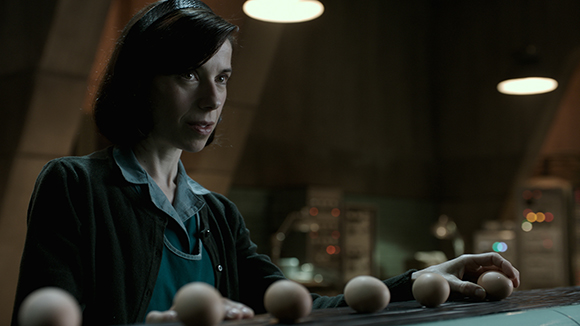
TORONTO — Guillermo del Toro’s latest film The Shape of Water is set in 1960s America, a time when the US was competing with the Soviet Union to send a man into space. Elisa (played by Sally Hawkins) works as a cleaning lady at a hidden, high-security government lab outside of Washington, DC. A mute, she lives an isolated life, communicating only through sign language with long-time co-worker Zelda (Octavia Spencer), and her artist/neighbor Giles (Richard Jenkins). Upon discovering a classified lab experiment, Elisa recruits Zelda and Giles to help free what the government has labeled simply an “asset” — portrayed by Doug Jones — that can help the country advance in the space race.
“That was about three years ago,” Wolinsky recalls. “I got to work with him on that pilot and then he asked me to do this film.”
That prior experience gave him a feel for how director Del Toro works. “He works with his editor on a daily basis,” Wolinsky explains. “He doesn’t really give any direction before. We really just work day to day on each scene and build the film together. There is never any question in my mind about what he wants because he is always there to tell me what he wants.”
The feature was shot out of sequence, so while Wolinsky was receiving footage following the previous day’s shoot, he was not working in a linear fashion. “It was boarded to be shot probably the most efficient way, so that all scenes in one location were shot at the same time,” he notes.
The edit, he says, was very collaborative. “Guillermo may come in and give me feedback on my cut, and I may change it, and later I might get ideas and bring them to Guillermo. If he likes them, we’ll do them. Or, I might have done a version and the execution wasn’t right, but because he understood what I was going for, we’d work towards a common end with that change.”
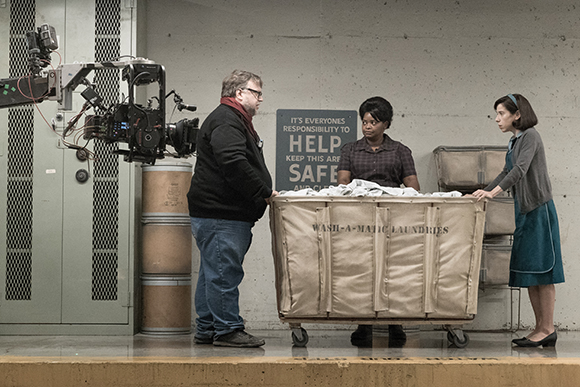
Even on the mixing stage, when the edit is thought to be locked, changes can occur. “If there’s something that’s not working, we’ll go back to the cutting room to fix it and adjust the sound accordingly.”
Dennis Berardi, the film’s visual effects supervisor, and the team at Mr. X in Toronto, delivered more than 600 shots for the film, including digital doubles, bio-luminescence, additional wetness, CG environments, water and fluid effects, and visuals that reinforced the Baltimore setting, including buildings, signage and vehicles.
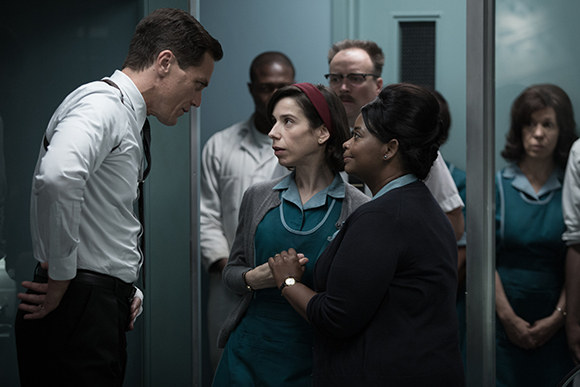
Visual effects, says Wolinsky, is an area that director Del Toro “is an incredible genius in, to be honest. There is no detail that he misses. He has worked with Dennis a lot in the past. They work really well together.”
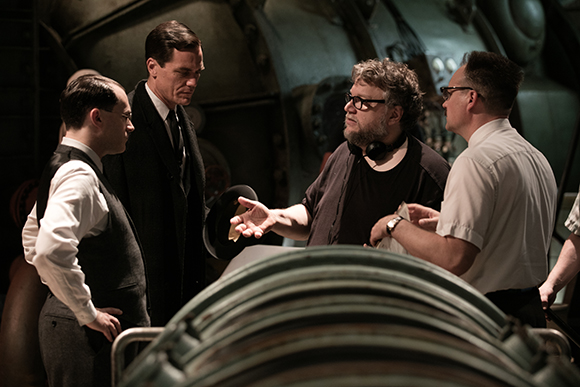
“We started in August (2016),” he recalls. “We locked the end of April (2017). We took a hiatus for May and June because the score was not going to be ready until the end of June. I went back to Toronto in July for the dub. I was on the dubbing stage in Toronto and it was finished the end of July.”
Looking back at the finished film, Wolinsky sees two particular scenes that he’s extremely proud of. One is when Elisa is trying to persuade Giles to help her break the creature out of captivity. “I think that was a wonderful, wonderful scene, and it plays really well,” says the editor. “I thought I did justice to the performances that they gave, which were fabulous…I thought it was a great idea to have her insist that he repeat back what she was saying so she was sure that he understands what she is talking about. The brilliance is, he is ‘her’ voice, and the edit works. It doesn’t feel phony. In the context, it works really well because she is insisting and he is relenting.”
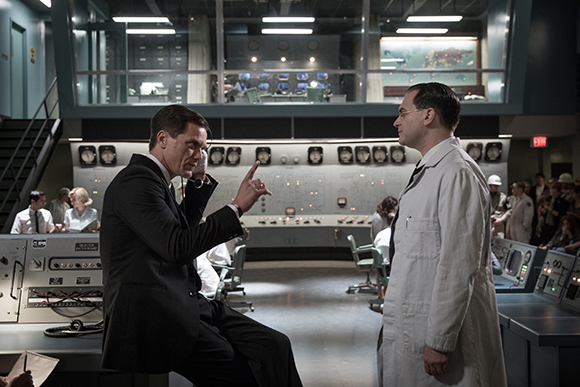
His Oscar nomination, he says, is both exciting and unexpected. “I had been cutting primarily television,” he reflects. “What a stroke of luck to end up on a film that is so successful!”

Latest


Sponsored

Sohonet’s Media Fabric
Sohonet has launched Media Fabric, a suite of managed infrastructure solutions for film, television and post-production, designed to simplify the growing complexity behind modern workflows.

Issues